Setup fee: $150 Commission: 15% of $3,000 = $450 Interest: 6% of $3,000 = $180 100 Announcement Cards: 100 cards @ 50c = $50 Rush service fee: $25 Total Revenue: $855 That's $855 that could have been spent on the honeymoon itself. Ouch.
Tuesday, January 30, 2007
How Honeymoon Registries Get Rich Off Your Money
Great article from Make Love Not Debt. Example, based on $3000 honeymoon:


Monday, January 29, 2007
GWC is cold. But proud.
Freezing the GWC ass off in Minneapolis, but just wanted to quickly note - we're braggarts round these parts - that GWC is the #2 Google result for How do dolphins crap?
We apologize for our inability to assist in this matter, and wish the researcher all the best in his or her investigations.
More hankies!
A wonderful gift for your Mother to dry her tears as you wed. "Mother…This loving reminder for all the years you dried my tears".
 My own mother would glance at this suspiciously before dismissing it (and rightly so) as "too little, too late."
Thursday, January 25, 2007
A fabulous cake deserves fabulous balloons
Thanks to a timely report from Agent ChgoRed, GWC is delighted to present Castle Cakes!
 More delicious confections here.
More delicious confections here.
Wednesday, January 24, 2007
Want. Must Have.
The hysterically funny mb over at Blonde Champagne is breaking my heart with her pictures of inflatable wedding arches. This woman is brilliant.
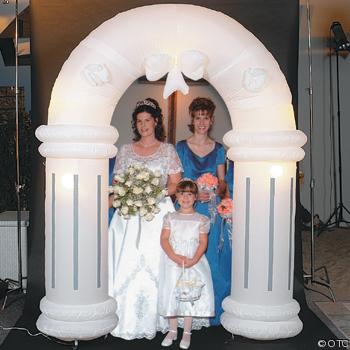
I could die unless I get my hands on one of these beauties, and yet no amount of Googling is turning up a supplier. Sheesh!
Update: The fabulous Cathy hunted down a link where you can buy such a lighted, inflatable arch. Here you go - but hurry, there's only three left!
While you're at it, why not pick up an inflatable wedding cake?
Tuesday, January 23, 2007
More Irish wedding goodness

You may want to dress in formal bridal wear or the bride and her attendants could dress as Irish maids or pixie fairies. The groom, along with his groomsmen, could dress like Irish gents or leprechauns.
But wait, there's more:
Create a rainbow behind the head table from poster board, each end anchored in a large cast-iron pot. Fill the pots full with newspapers then place a circle base on top of this cut from cardboard. On top of the cardboard, place chocolate gold-foiled "coins". Cut the bride and groom's first names from cardboard and color in emerald green. Spread watered glue mix and sprinkle sparkles on the names. Secure to the hang from the rainbow.
Or why not "create a "blarney stone" from paper mache and place just inside the doorway as people enter"?
More ideas here.
In all fairity, as our old neighbor would say, in all fairity I must point out that the author notes that this is not actually a traditional Irish wedding.
Which leads me to a story.
Around the time of the last presidential primaries, I took myself off to Seattle Center to watch the Democratic caucus. I was listening in on a group of Kucinich supporters, and when the leader asked me for my opinion, I uncharacteristically declined to give it, saying that I wasn't a citizen, and was only there to observe.
"Where are you from?" he asked.
"Ireland," I said, and he grasped my hand. "Welcome!" he said enthusiastically, shaking my hand in earnest good fellowship, "Welcome -- to democracy."
Monday, January 22, 2007
Holymotherofgod Irish wedding favor

This traditional "Irish Blessing Wedding Favor" features two rather gaudily dressed short fellas sliding down a banister.
Available here or by calling 1-866-IRISH-4U.
God, I'd kill for that number.
Saturday, January 20, 2007
Wedding Day Survivor Mug

Wedding Day "Survivor"? ... You'll LOVE this coffee mug from Beverly Clark. A great gift for Mom or Dad! Includes a fun Survivor-like logo declaring "Over Did, Over Spent, Over Stressed" surrounding a bridal couple in an oval. Available with blue or orange logo.I think it would be totally cool to use this in front of your son-in-law every single visit. Get it here.
Friday, January 19, 2007
Rules for Marriage

Thanks to Never teh bride for pointing me back to these. Avoid enternal hellfire by following the rules here.
I suspect most of you minxes reading this would also profit from Instructions for Women.
Thursday, January 18, 2007
For those who worry that the woman in the veil will go unnoticed on the day
I am honored to draw your attention to U.S. Patent No. 4,604,760, in which inventor Sheri K. Coin of Billings, Montana, resolves a familiar problem:


In an attempt to achieve a bridal headdress that coordinates better with current hair and makeup styles, many brides are turning to very casual designs such as wreaths, bands, hats and the like. ... Another factor that may influence a bride's selection of a headdress is the fact that most people who attend the wedding generally are at a distance that does not permit discernment of fine details of the outfit. ... guests are within close range of the bride for only a few moments as they converse with the bridal party and the remainder of the time are at a considerable distance. Therefore, guests can only observe details of the bridal attire when they are quite large in size. From the above discussion, it is clear that presently available bridal headdresses do not provide desired solutions for many of today's brides. Thus, there is a need for a new bridal headdress that overcomes the deficiencies of earlier designs.
The solution? Ladies, an electric veil.
The illuminating portion 19 of the headdress 11 includes a plurality of spaced miniature incandescent lamps 36. The lamps 36 are spaced from each other and affixed along the length of the supporting portion 18. The lamps are retained in proper alignment by affixing the same to the supporting portion such as with an adhesive 37. The lamps 36 preferably have an elongated tubular configuration. Advantageously, the lamps include clear glass or plastic envelopes 38 and preferably are six volt lamps.I shit you not, my friends. I shit you not. Thus equipped,
A bride then can proceed with her normal activities associated with the wedding ceremony without concern or attention to the headdress. At appropriate times in the ceremony and/or reception, she can illuminate the lamps by reaching a hand under the veil and actuating the switch 50.
Skeptics can verify the above information here.
Wednesday, January 17, 2007
Fabulous wedding etiquette advice
"If you are like most people, you will waste a lot of time wondering about the proper way to address a female friend of yours who is a doctor, married and has kept her maiden name. "Um, no. Nope. Never. Why on earth would you? Hasn't she made it very clear how she wants to be addressed? Where is the problem here? And just in case you were
Avoid using Ms. in social stationery. It is typically more appropriate for business.Don't even think about it. More help here.
Thursday, January 11, 2007
National Delurking Week
You know something? I'm a bad blogger. (Wedding, honeymoon, new job, remodel, vacation ...) But I've been inspired, and will be posting more regularly from tomorrow. In the meantime, go check out Offbeat Bride -- right here in snowy Seattle.
And hey - it's delurking week. I don't always comment myself, but I just squeal with delight when someone leaves me a comment. (Unless it's just plain mean. And even then ...) I'd just love it if you left a comment - it would be awesome to see who drops by, what you're thinking, who you are, and where you do the blogging yourself.
Here's to a nonGodawful 2007 to you all.


Subscribe to:
Posts (Atom)